This page is only available in Chinese for now.
学德语
一个自学德语的网站:A1 到 C1 的知识点排成科技树,每个专项的速查页和练习免费开放;闯关、背单词和跟读是 Niuance+ 功能。
Self-taught German · A1–C1
German, piece by piece
From pronunciation to the subjunctive, in the order most courses teach it, laid out as a tech tree. Every point has a reference page – rules, tables, examples – with a drill right next to it. Read it, practise it, come back when you get it wrong.
- 65grammar points
- 19drills
- 101verb families
- 759separable verbs, each with an example
02
Tables that follow your words
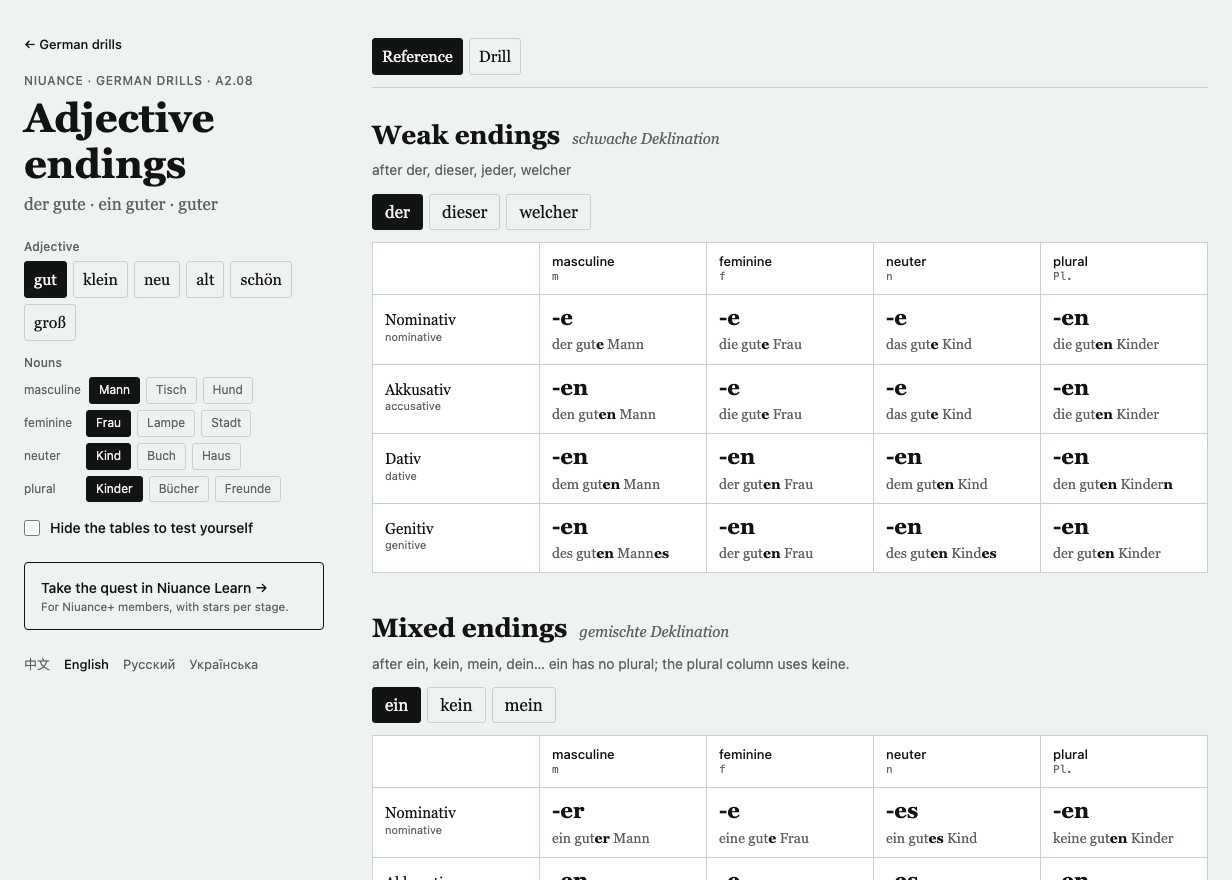
Adjective endings and article declension are not a table to cram: pick another adjective or noun on the left and the whole table changes, endings in bold. Hide the tables to test yourself.
03
One root, one word cloud
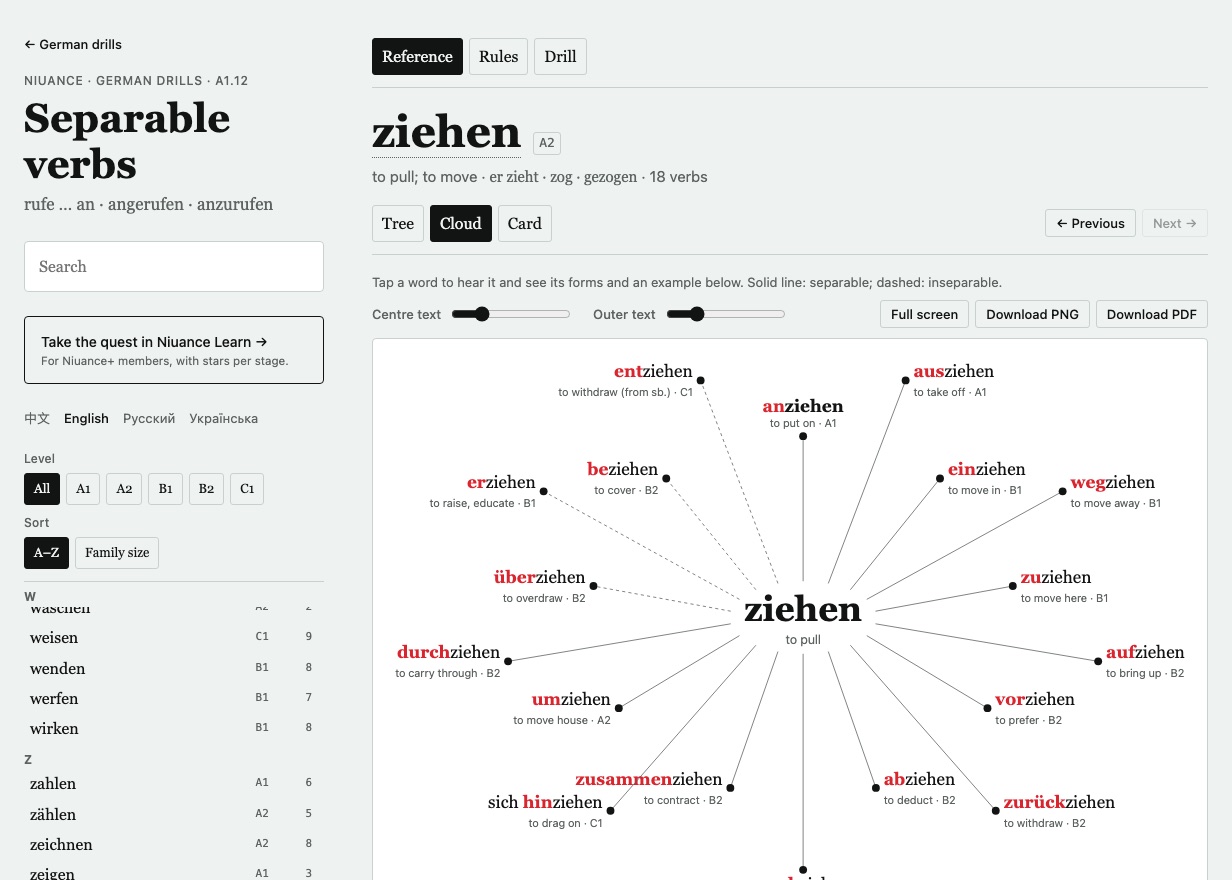
ziehen brings anziehen, umziehen, erziehen and fifteen more. Solid lines are separable, dashed ones are not. Filter by level, sort by family size, change the type size, go full screen.
04
Tap a verb for its forms and an example
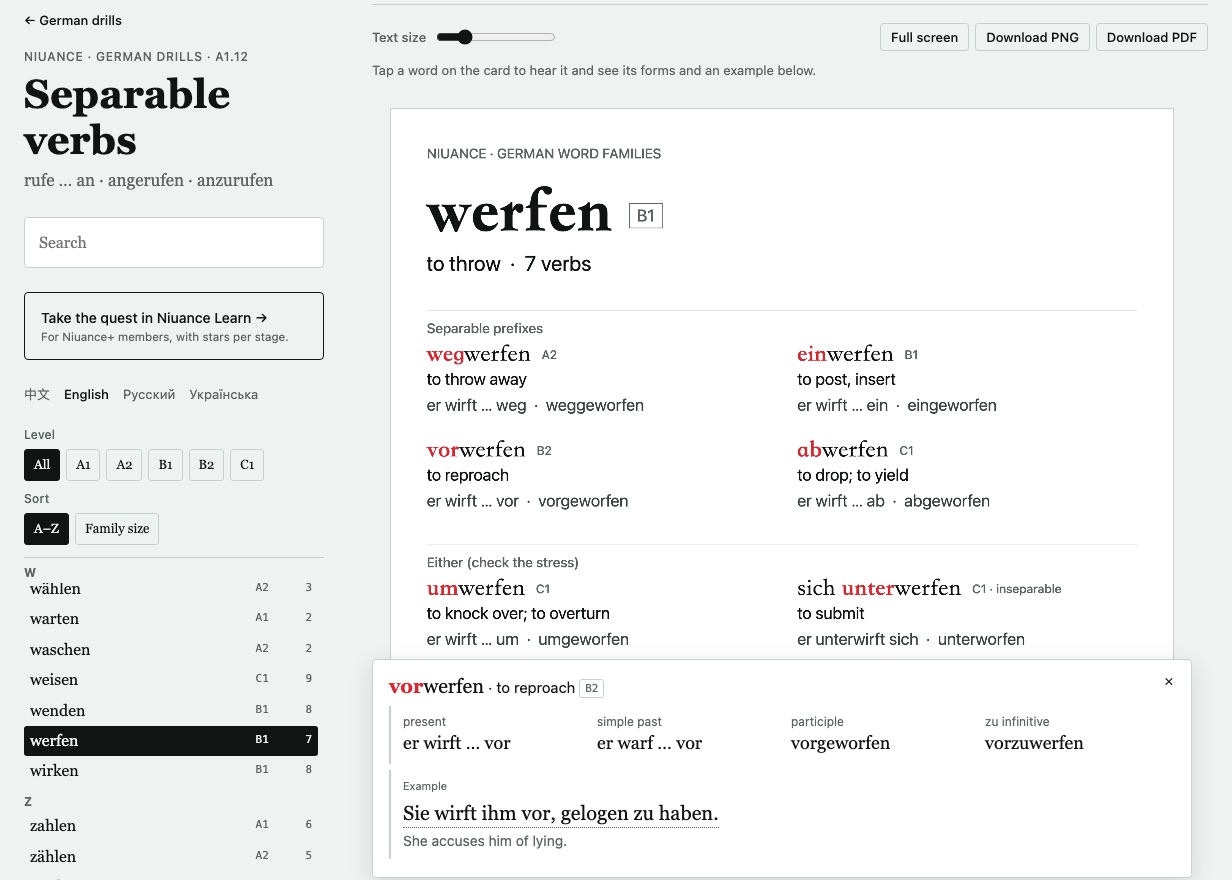
101 families, 759 derived verbs, each with four forms and an everyday example that is read aloud when you tap it. The whole card downloads as PNG or PDF, ready to print.
05
One small word, one page
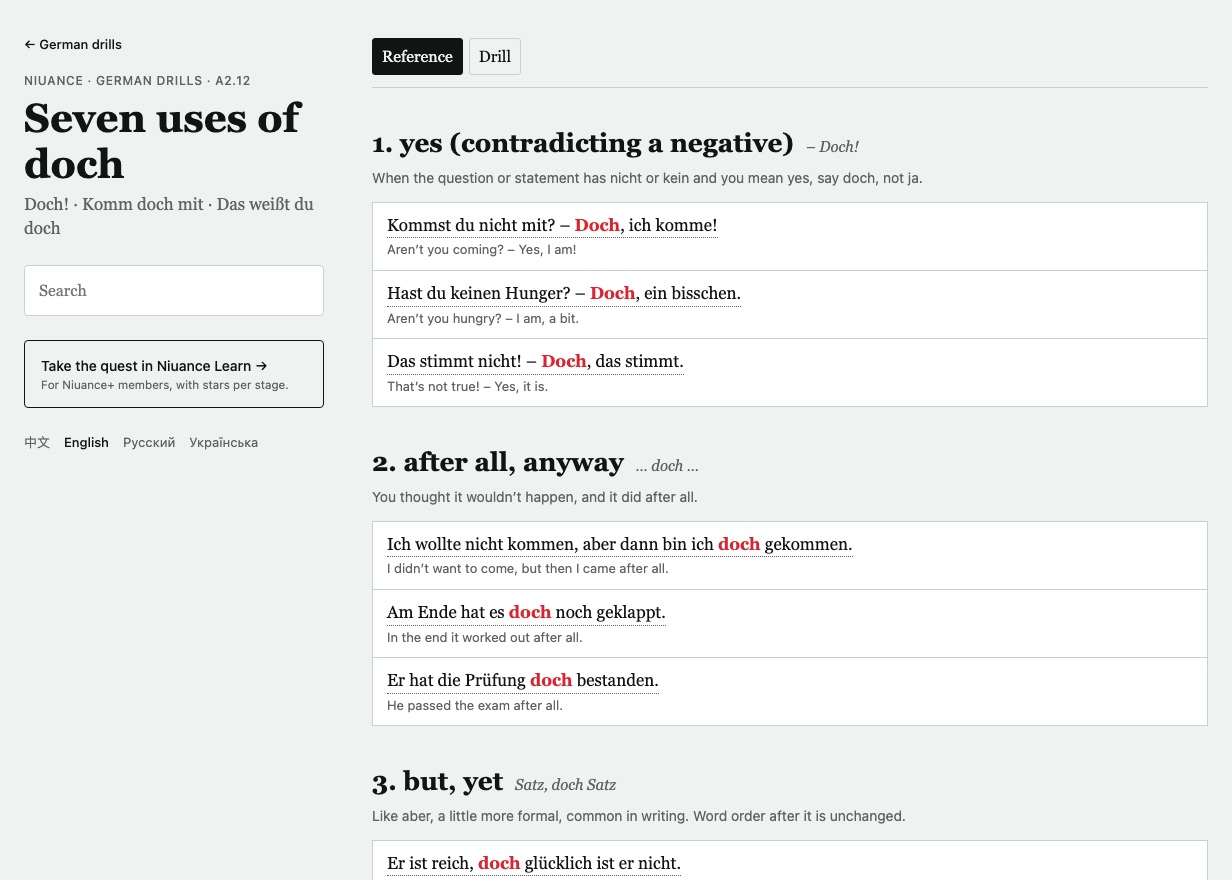
doch, schon, noch, mal, eigentlich, lassen: the hardest words to teach. Each use gets its own section and a few lines of dialogue.
06
Every page has a drill
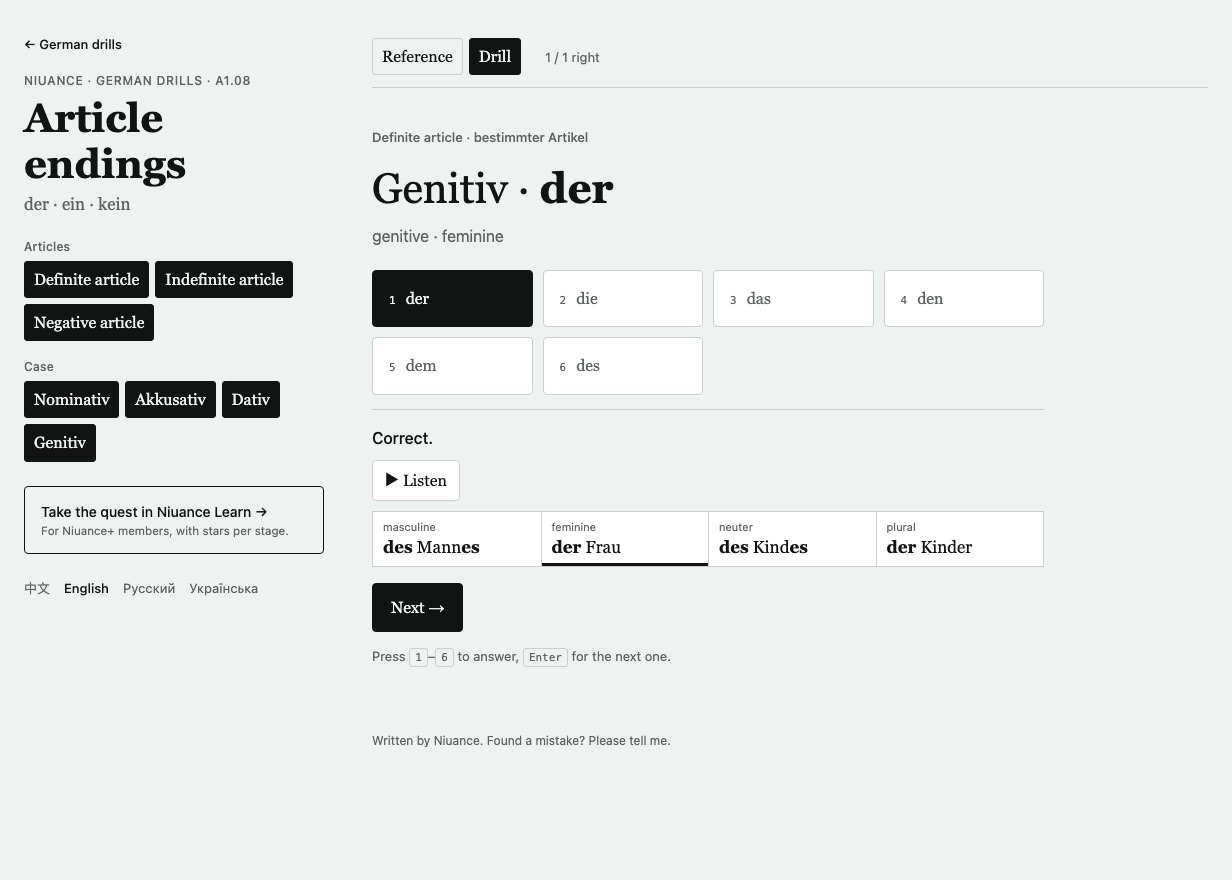
The drill sits next to the reference. Answer with keys 1–6 and see at once where the form sits in the table. Reference and drills are open to everyone, no sign-in needed.
The tree, every reference page and every drill are free, in Chinese, English, Russian and Ukrainian. Quests with stars, WordLoop vocabulary and ShadowLoop shadowing are part of Niuance+.
这是我自学德语时一点点搭起来的网站。最开始只是几张速查表,后来加了练习、闯关、背单词和跟读,现在都放在 Niuance 学习里,地址是 learn.niuance.com/de。
先看科技树
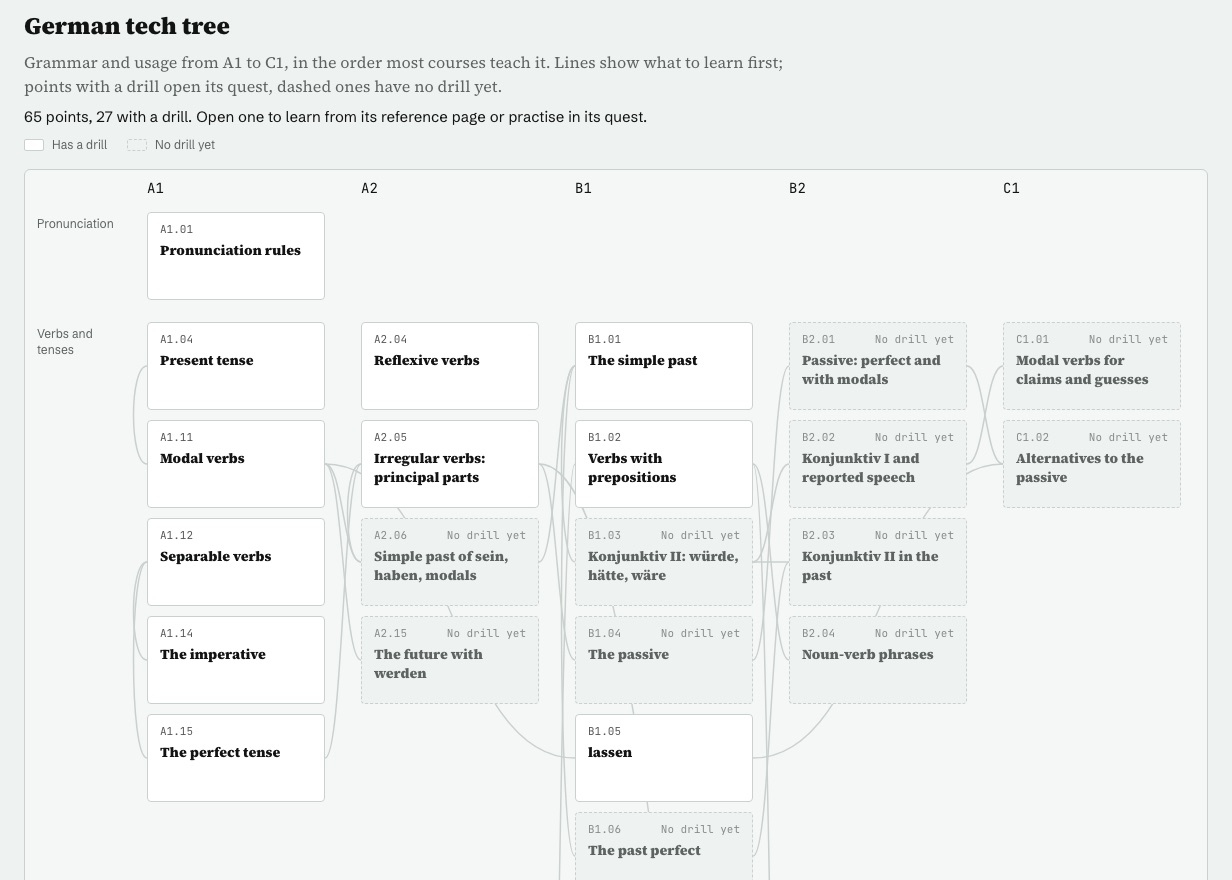
我把德语语法从 A1 到 C1 的 65 个知识点,按大多数教材的顺序排成了一棵科技树。横向是级别,纵向分成八个分支:发音、动词与时态、名词冠词与格、代词、形容词、介词、句子结构、词的用法。连线表示学一个点之前,最好先会哪个。
每个点都有序号,比如可分动词是 A1.12。已经做了专项的点可以直接打开;还没有专项的也列在树上,哪些学过了、哪些还没碰,一眼就能看出来。
专项:学和练
现在有 19 个专项,覆盖 27 个知识点。每个专项分两部分:
- 学:速查页。规则、表格和例句,例句点一下就能听(用的是浏览器自带的德语朗读)。速查页带一个不限题数的练习,答错的题过几题会再出现。
- 练:闯关。每关 10 题,答错三次就没过,过关按错题数得一到三颗星。每章最后有一关全章挑战,另外还有不分章节的大乱斗。
速查页和上面的练习对所有人开放,不用登录。闯关需要 Niuance+。
背单词和跟读
- WordLoop 用闪卡背词。每个词学过之后都有自己的复习时间(FSRS 算法),到期就回到当天的练习里,练法在闪卡、选释义和听写之间换。词库按 A1 到 C2 分级。
- ShadowLoop 逐句播放视频,跟着读一遍,给每个词的发音打分;点句子里的词可以直接查词库。
这两个也是 Niuance+ 的功能。
怎么开始
不知道从哪儿开始,就从科技树最左边的 A1 往右看,找到第一个还不熟的点。先读速查页,做几题练习;觉得差不多了再去闯关。科技树会按你拿到的星数,标出哪些点已经掌握。
Niuance+ 可以先免费试用 3 天,不需要付款信息。
内容和来源
规则、例句、释义和题目都是我自己写的。WordLoop 的词库只用可以商用的开放数据:Wiktionary(CC BY-SA 4.0)、wordfreq(CC BY-SA 4.0)和 Tatoeba 的例句(CC BY 2.0 FR),来源和许可写在学习网站的“来源与许可”页上。
界面有中文、英文、俄语和乌克兰语。发现错误,请在下面留言告诉我。
Each drill carries its number in the German tech tree. The whole tree, including the points that have no drill yet, is in Niuance Learn: Open the German tech tree ↗
Vocabulary and shadowingNiuance+
- WordLoop
Vocabulary
Each word you learn gets its own memory curve (FSRS). When it is due it comes back in the day’s practice, as a flashcard, a meaning to pick or a word to write from dictation.
Niuance+Open ↗ - ShadowLoop
Shadowing
Play a video one sentence at a time, say it after the speaker and see a pronunciation score for every word. Tap a word to look it up.
Niuance+Open ↗
A1 · Beginner8 drills
- A1.01PronunciationStaat · Stadt · Buch · ich
Pronunciation rules
German is read as it is written: long and short vowels, ä ö ü, ei and eu, b d g at the end, s and sp, the five ways to say ch. Tap any example to hear it.
Reference · drill →Quest ↗ - A1.03Pronounsich · mich · mir · sich
Personal and reflexive pronouns
From ich, mich, mir to sich: nine persons in the nominative, accusative and dative, and the reflexive pronouns.
Reference · drill →Quest ↗ - A1.04Verbs and tensesich fahre · du fährst · er fährt
Present tense
Regular verbs, stem changes (fährst, liest, nimmt), modal verbs and sein, haben, werden, wissen in the present tense.
Reference · drill →Quest ↗ - A1.07Nouns, articles, casesdie Zeitung · das Mädchen · die Häuser
Noun gender and plural
Guess der, die or das from the ending or the meaning, with the exceptions side by side; the ways German forms plurals.
Reference · drill →Quest ↗ - A1.08Nouns, articles, casesder · ein · kein
Article endings
The definite, indefinite and negative article in all four cases: three tables and a few rules.
Reference · drill →Quest ↗ - A1.12Verbs and tensesrufe … an · angerufen · anzurufen
Separable verbs
When the prefix moves to the end and when it stays attached, where ge and zu go; which prefixes split, and how stress tells you with um-, über- and the like.
Reference · drill →Quest ↗ - A1.14Verbs and tenseskomm! · kommt! · kommen Sie!
The imperative
How to tell du, ihr and Sie, and how to say “let’s”; when the du form takes -e, when e turns to i, why a stays a; separable and reflexive verbs in commands.
Reference · drill →Quest ↗ - A1.15Verbs and tensesgehen · ging · ist gegangen
Irregular verbs
Past tense and past participle of common strong and irregular verbs, and whether the perfect takes haben or sein; grouped by vowel pattern.
Reference · drill →Quest ↗
A2 · Elementary7 drills
- A2.03Prepositionsmit dem · für den · in den / in dem
Prepositions and case
Prepositions that always take the dative or the accusative, two-way prepositions (where? or where to?), genitive prepositions, and contractions such as im and zum.
Reference · drill →Quest ↗ - A2.07Adjectivesalt · älter · am ältesten
Comparatives and superlatives
Comparatives and superlatives: which adjectives take an umlaut, which add -esten, and the irregular ones such as gut, viel, gern, hoch and nah.
Reference · drill →Quest ↗ - A2.08Adjectivesder gute · ein guter · guter
Adjective endings
Weak, mixed and strong endings: the adjective after der, after ein, or with no article.
Reference · drill →Quest ↗ - A2.11Words and particlesSchau mal · schon mal · nicht mal
Seven uses of mal
Times, just, some time, ever, used to, not even, that’s how it is: the little word you hear all day and textbooks barely mention.
Reference · drill →Quest ↗ - A2.12Words and particlesDoch! · Komm doch mit · Das weißt du doch
Seven uses of doch
Contradicting a negative, after all, but, go on, as you know, really!, if only: examples by use, plus how to answer with Ja, Nein or Doch.
Reference · drill →Quest ↗ - A2.13Words and particlesschon fertig · schon mal · Das wird schon
Seven uses of schon
Already, ever, it’ll be fine, yes but, come on, alone, rhetorical: examples by use, plus schon or erst.
Reference · drill →Quest ↗ - A2.14Words and particlesnoch nicht · noch einmal · nur noch
Eight uses of noch
Still, not yet, more, again, even, only … left, in time, what was it again: examples by use, plus noch, schon, erst and nicht mehr side by side.
Reference · drill →Quest ↗
B1 · Intermediate4 drills
- B1.02Verbs and tenseswarten auf · denken an
Verbs + prepositions
180 fixed verb + preposition combinations, each with an example, its case and the wo-/da- forms.
Reference · drill →Quest ↗ - B1.05Verbs and tensesreparieren lassen · Lass uns gehen · Lass das!
Seven uses of lassen
Have something done, let, let’s, leave, leave as it is, stop, can be done: examples sorted by use, plus lässt, ließ, gelassen and where “make” is not lassen.
Reference · drill →Quest ↗ - B1.13Sentence structureentweder … oder · weder … noch · je … desto
Paired conjunctions
entweder…oder, weder…noch, sowohl…als auch, nicht nur…sondern auch, zwar…aber, je…desto, einerseits…andererseits: meanings, examples and the word order that trips people up.
Reference · drill →Quest ↗ - B1.15Words and particlesEigentlich …, aber · Wie spät ist es eigentlich?
Five uses of eigentlich
Actually, by the way, basically, what on earth, real: one word that changes meaning between statements and questions.
Reference · drill →Quest ↗
Tables, rules and examples written by Niuance. The reference pages come in English, Chinese, Russian and Ukrainian.
Comments
No comments yet.